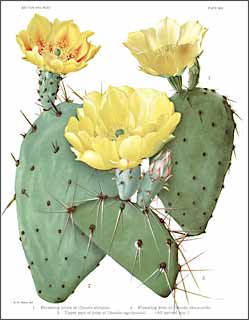
| Mary Emily Eaton was an English botanical illustrator who worked at the New York Botanical Garden (NYBG) and created the illustrations for Britton and Rose's The Cactaceae. Although she never had formal training in botany, she received an art education at the Taunton School of Art, Chelsea Polytechnic, and the Royal College of Art. During her early years, Eaton worked as a porcelain painter at Royal Worcester. In 1909, she began painted studies of moths and butterflies when she visited her brother in Jamaica. After two years, she moved to New York City, where she was soon employed by the NYBG. Eaton worked for the NYBG for nearly 20 years and was the primary illustrator for their journal Addisonia, creating 640 of its 800 plates. Many of these plates depicted cacti and were used for the vast majority of illustrations in The Cactaceae. During this employment, National Geographic also hired her to illustrate wildflowers for several projects including The Book of Wildflowers. Eaton was known to be a fast and efficient painter and was said to start and finish a painting in just half a day without compromising her impeccable draftsmanship and mastery of light and shadow. Otto Degener, who shared an office space with her, alleged that she may not have even used a pencil to outline her drawings before applying watercolor. She was a two-time recipient of the Royal Horticultural Society's Grenfell medals: the Silver in 1922 and the Gold in 1950. During the Great Depression, Eaton unfortunately lost her job at the NYBG due to lack of funding. Not having luck finding enough work in the U.S., she eventually returned to England and remained there for the rest of her life. Her paintings now reside at the British Museum of Natural History, the NYBG, the National Geographic Society, and the Smithsonian. |






 Wikipedia